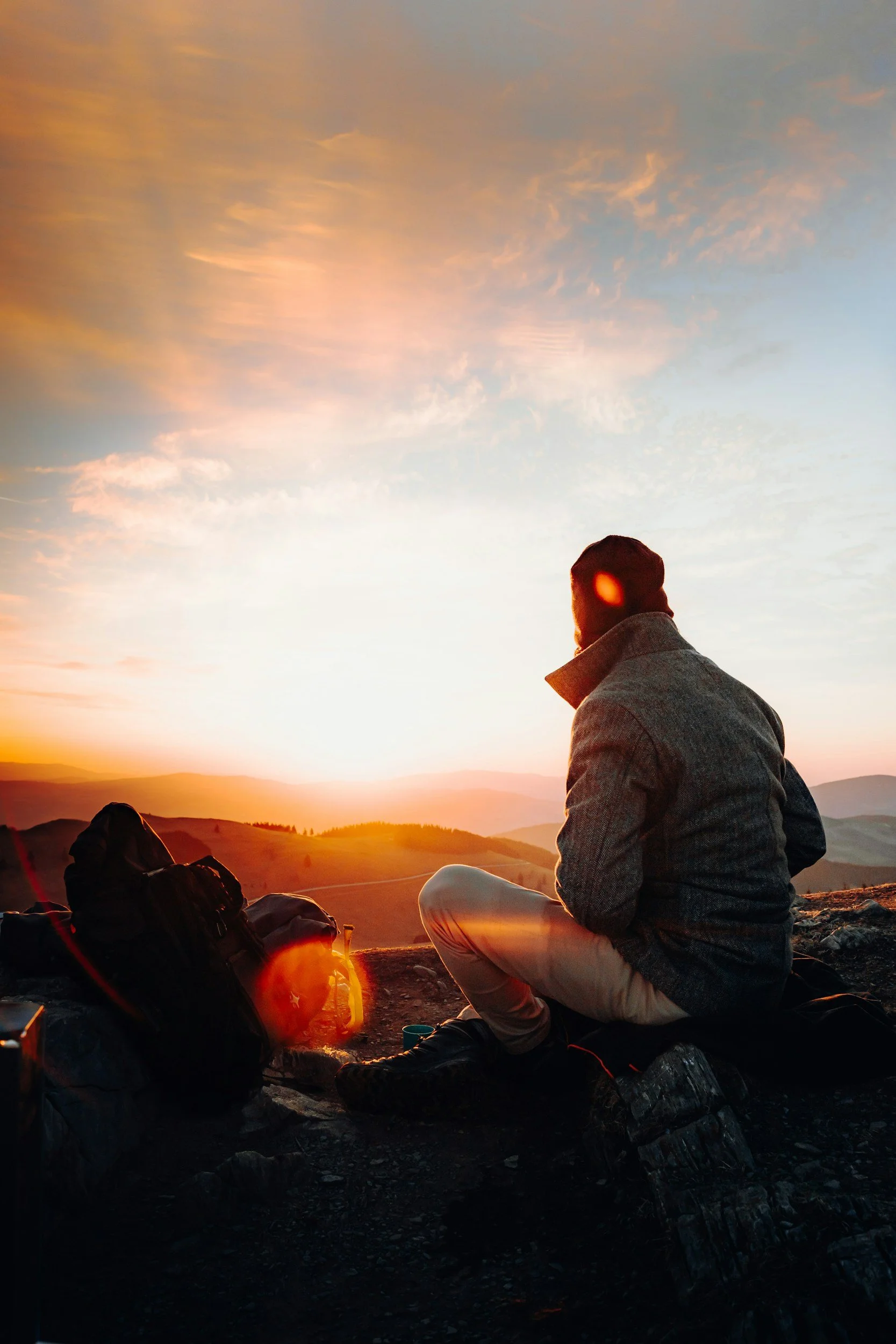
You are an explorer..
Your mission is to document and observe the world around you as if you’ve never seen it before.
Take notes. Collect things you find on your travels. Document your findings. Notice patterns. Copy. Trace. Focus on one thing at a time. Record what you are drawn to.
— Keri Smith
THE SENSORY DOORWAY
Right now, as you read these words, your senses are already at work. Light is reaching your eyes. Air is touching your skin. Sounds near and far are arriving. You don't have to do anything to make this happen. The senses are always open, always receiving, always here.
What if this ordinary, ever-present sensory aliveness is the most direct doorway you have to something extraordinary?
The same senses that help us navigate the practical world are also instruments of a deeper knowing. When we slow down enough to actually meet what our senses are receiving - like the warmth of a cup in our hands, the quality of light in a room, or the taste of something fresh from the garden - we begin to notice something more than information. We notice qualities. Qualities like spaciousness, aliveness, clarity, and depth. We can discover a sense of wholeness that has everything to do with what's actually here.
These are what I call essence qualities and the senses are how we find our way to them.

My Journey Through the Senses
I arrived this awareness through my body, through daily walks through the valley I live, through gardening, through cooking, through slowly learning to be present to what was actually around me.
For a long time, I hated the wind. Living in a valley in New Zealand, wind was a constant companion I didn't want. It swirled my hair, and roared in my ears. To me it pushed my already overwhelmed nervous system over the edge. I often fantasised about living somewhere calm and still. Somewhere that must be far away from here.
But as I slowed down through long slow walks in the valley, through the repetitive rhythm of gardening, or through simply being present to what was around me, my senses began to open in a new way. I started noticing qualities in my experience. There was a spaciousness in the deep blue sky, an vibrancy in the birdsong, the aliveness of my feet massaging the earth. Without knowing it, I was beginning to come home to my own essential nature, and as I did, my capacity to meet what was here began to change.
One day, turning to walk home on a meadowtation, I noticed how blustery it was and that I wasn't bothered. In fact, I was enjoying it. The swift fresh air softly caressed my skin as it blew firmly into my face and body. I paused to breathe it in deeply. The dynamic movement of nature was actually bringing life force to me, just as I was bringing a dynamism to this moment.
From that day on, I didn't seek to live somewhere with no wind. Something had shifted, not in the wind, but in me. As I continued my journey in this way I further became the still space for the wind to swirl and blow as much as it liked.
Looking back, I could see that my rejection of the wind had mirrored a deeper disconnection. As I embodied more of my own essential nature, I was embodying the wind. The very thing I had pushed away was actually a teacher.
This is what the sensory doorway does. It doesn't ask you to add something to your experience. It invites you to discover that what's here is far more than you thought.
Our relationship to our senses
The sensory doorway can serve people coming from very different places, and it brings something needed to each.
We all develop a relationship with our senses early on, and like any relationship, it can take on a particular pattern. Some of us become anxiously attached to sensory experience: here everything can become amplified and we feel everything intensely,. We notice everything and can be flooded by beauty and overwhelmed by noise, and unable to regulate how much is coming in. We swing between craving sensory richness and needing to shut it all out.
Others develop a more avoidant relationship: here the senses recede into the background, the body becomes something below the neck that does its job, and whole dimensions of experience go unnoticed because we've learned to live at a comfortable distance from them.
Most of us lean one way or the other to various degrees. Both are ways of not quite being at home in our embodied experience. And the sensory doorway meets both, gently opening the door to something new.

If you're someone whose senses tend to be amplified..
If you feel a lot, notice a lot, and sometimes find it all too much, this path won’t be about managing that intensity or affirming it. Rather it will cultivate something underneath it - a ground of presence from which sensation can be met differently. Through gentle, often nature-based practices that involve noticing what you're drawn to and following your curiosities, a new relationship with your senses begins to form. One that is more spacious and grounded, and more true.
If you're someone who has lived mostly from the mind..
If you orient toward concepts, analysis, planning, and achieving, this path won’t force you to feel more. Rather it will be about about gently following what you are drawn to and noticing what shows up in your senses around this. You may be surprised to discover how much richness is available in the taste of your morning coffee, in the quality of light at a particular hour, in the feeling of your feet on the earth. Through simple, embodied practices, a whole dimension of experience that's been waiting quietly in the background begins to come alive in your way of being.

Both directions lead to the same place: a secure, grounded, trusting relationship with our own embodied experience, in other words becoming truly at home in the body. And from that ground, something new becomes possible. The senses begin to reveal qualities like spaciousness, clarity, aliveness, warmth, and even wholeness. Qualities that were always here but couldn't be perceived from either intensity or distance. This is essence recognition, and it's available to everyone, through the senses we already have.
For either path, this approach grounds us in our bodies in a balanced and necessary way, and provides the foundation from which to come into our wholeness more fully. The body becomes a home, a gift even, rather than a problem to solve.
An Invitation
To slow down. To explore. To be curious. To go on a sensory treasure hunt and see what you find.
From here, it opens. Into how you hold your own inner life with more spaciousness and tenderness.
The senses have always been open. The doorway has always been here. The invitation is simply to walk through.




Stay connected
Join the journey toward essence recognition
Receive reflections on essence qualities and the senses, invitations to explore, and news of retreats and offerings.